by Sawan White | Oct 12, 2026 | paintings
Time is a curious thing
Time is a curious thing. We are surrounded by countless ways to measure it, manage it, and use it wisely. Yet, in reality, time cannot be held, stored, or revisited. It is the medium through which we build our lives and relationships, mark milestones, and map our memories.
For the most part, we understand time to be constant, passing with the predictable precision of a clock. A minute is a minute, a second a second. The clock on my phone matches the clock on yours. But the scientific concept of time dilation challenges this familiar understanding. Rooted in Albert Einstein’s Theory of Special Relativity, time dilation describes how the passage of time varies depending on an observer’s motion and gravitational environment. Without diving into a physics lesson, the essential idea is that forces such as speed and gravity can alter the rate at which time passes for an observer. For most of us, these variations are so subtle that they remain imperceptible; our clocks continue to align with those around us. The physical science of time dilation, therefore, remains largely an abstract concept in everyday life. Fortunately, I am an abstract artist, and abstraction is where I find natural home.
I began to consider not the physical perspective of an observer, but the emotional, mental, and spiritual dimensions of experiencing time. How might the gravitational pull of a life-altering event, or the velocity of a changing relationship, alter the way time unfolds for an individual?
We have all experienced moments when time seems to drag endlessly or race forward in a blur. Think back to childhood, waiting for a birthday to arrive or for school to end for the summer. Those days could feel interminable. As adults, we may experience the same sensation during a seemingly endless workday, while vacation days disappear almost as soon as they begin. Our perception of time shifts according to our emotional and mental relationship to the moment. This, to me, is time dilation from a different perspective.
My lasts and firsts
Last year, my only child left for college. That transition was marked by a succession of lasts and firsts that left my mind spinning and my heart aching. It was beautiful, exciting, and terrifying all at once. Time behaved strangely during this period: some moments seemed to retreat into memory almost instantly, while others lingered vividly in my mind. The days felt long, yet the months passed quickly. It was a profound reminder of how unpredictable and malleable our experience of time can be.
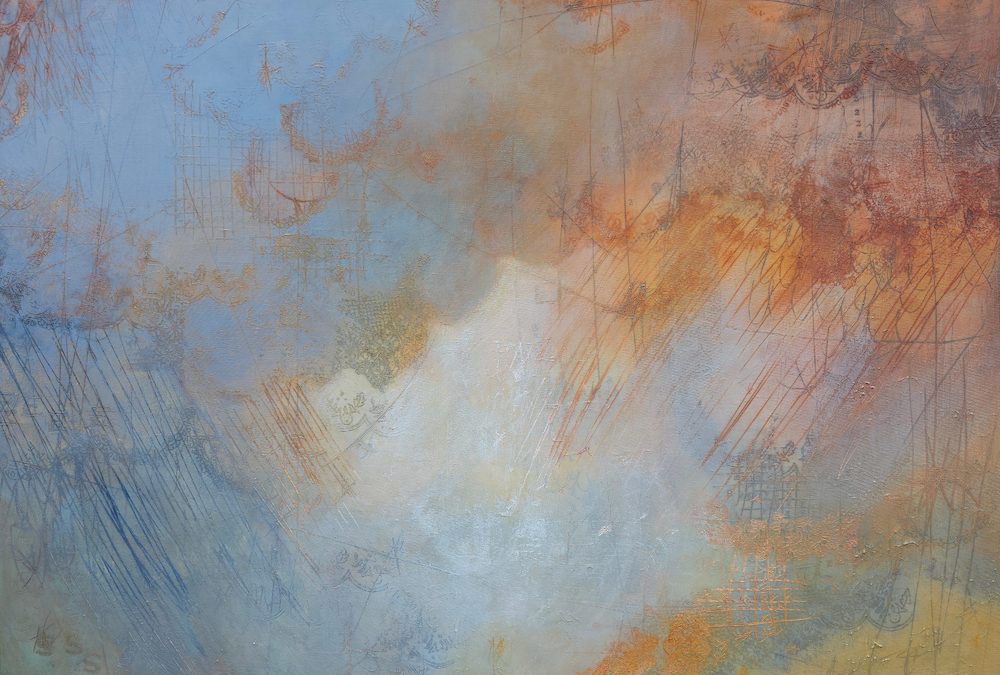
This body of work explores these observations and the ways our understanding of time transforms in response to our circumstances, age, experiences, and emotional states. Each piece gathers moments, both significant and seemingly insignificant, while shifting the perspective from which they are experienced and remembered.
time in paint
Grid-like forms appear throughout the series, evoking the structure of a calendar. At times, these grids recede to the edges of the composition, their colors barely visible; at others, they divide the surface into clearly defined spaces. Days sometimes appear expansive and vivid, while at other times they quietly slip toward the margins. Layers of pattern in the backgrounds suggest successive layers of wallpaper, traces of what came before, repeatedly concealed yet never entirely erased. Each painting becomes a record of time as a layered, evolving experience—a gathering of the emotional and mental moments that accumulate to shape our understanding of an event or period in our lives.
The fickle nature of time emerges through contrasts between the constrained and the ethereal, the representational and the abstract. Throughout the series, imagery shifts between recognizable forms and deliberate ambiguity. We are never just one thing, and neither is time. Some moments contain the weight of a lifetime: pivotal experiences that become permanently etched in memory, blurring the boundaries between past and future. Others are simply steps along the way, absorbed into the ordinary rhythms of daily life and eventually forgotten.
There is one constant in our experience of time: it moves in only one direction. We cannot return to what has passed. Yet we continually find ourselves wishing to accelerate or slow its progression, shifting our perspective in the hope of changing what cannot be changed. This is both the beauty and the heartache of time.
Our identities and relationships are in a constant state of transformation. We gather experiences, carry memories, and move through moments that shape who we become. Ultimately, all we can do is seek to anchor ourselves in what matters most—in the connections, relationships, and experiences that endure. We build our lives from everything we gather along the way.
May we build them well.
by Sawan White | Nov 13, 2025 | paintings
This September my child went to college. My only child (who is actually no longer a child). My daily household shrunk by 33%. I spent the last year trying to prepare myself for the strangeness that would be a house without him home every night, a schedule without all his activities, a day without his voice. I was only moderately successful.
I am (at least) two things that require more than 50% of who I am. Being a mother, I would argue requires at least 99% of who you are, if not more. And being an artist requires probably about 90%. For 18 years, I have juggled the math on both these things to try to do each one well. I rearranged schedules, set boundaries, drew inspiration, and created space for both these things simultaneously, along with the myriad of other things that I am. I have been 189% of a person just in these two spaces of life. I knew that this was a temporary part of living, that the challenge and goal of raising a child is to send that sweet being out into the world to live and grow and become the person they are meant to be. And I also knew, from the wisdom and experience of those around me, that this is easier said than done.
The past couple of months have been bittersweet and eyeopening. I have absolutely loved the glimpses I get into my son’s college life – hearing him talk about classes and friends, challenges and craziness. It’s been good for my soul. He is thriving, and that in turn inspires me to thrive. But I’m not going to sugarcoat the tiny kernel of sadness that simply sits there because I miss having him around. It’s the cherished sadness of loving someone missing in your daily life. But I knew I would be sad. What I hadn’t really realized was just how much I had changed my habits and practice as an artist over the past several years. I had grown used to wrapping my identity as an artist around my identity as a mom (yes, I know I’m still a mom, but not with the same everyday intensity). I had patterns of creation that are now missing, rituals of inspiration shored up with bits and pieces of momming things that now need different foundations. The challenge of being a mother (and artist) is changing the percentages at the right times, in the right ways. That’s the equation that I am in the middle of. I’ve been experimenting with what this new phase looks like, the schedules, the new constants, the new variables. What new things I have a little space for now and what remains solidly fixed into my creative process.
As I’m looking around my studio, I can feel a growing energy and excitement. I can see the potential in the new painting on the easel. I can smell the ink (that I didn’t clean up yesterday) on the bench. I can touch the newly cut paper ready and waiting to become something beautiful. When I climb the stairwell to my studio, I’m bringing 100% of who I am in a new way. All the conflicting feelings of being a mother without her child around, all the anxiety and hope of new time and new endeavors – all of it comes with me.
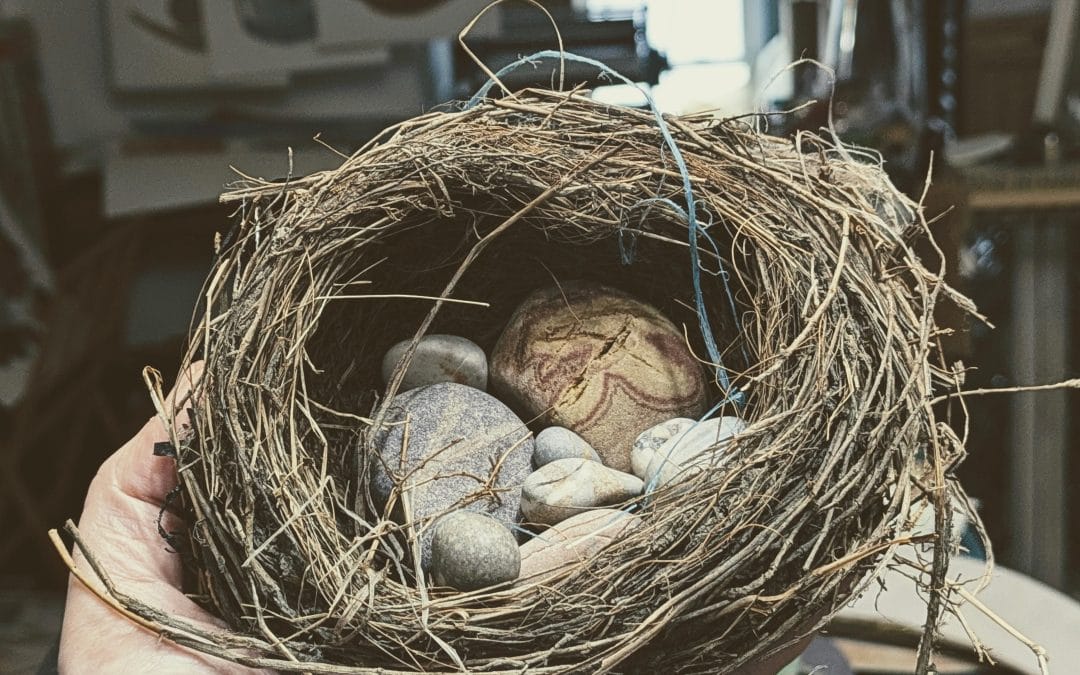
People used to tell me that everything changes when you’ve got an empty nest, so be prepared. It’s true. Pretty much everything is different. But the more I’m looking around, the more I’m realizing just how full and vibrant my nest is. I built it year by year, balancing motherhood with creating, until it could hold so much more than I ever thought. And now, woven into my little nest, the branches are resprouting.

by Sawan White | May 22, 2025 | paintings
Painting B Sides
Paintings are more that the finished image we see on the canvas. So much goes into creating a painting that the world never sees -all the foundational work not only in paint but in thought and concept. For me as an artist creating a painting is not just about laying colors down on a surface so they end up looking pretty; it’s about telling a story, capturing a moment, preserving a thought. These usually end up abstract, combining time and conversation and emotion into one solidified space. Over the years I have had so many requests to talk about a piece, explain what’s going on and always, always, talk about the title. I love titling my work. The title is always a clue, a prompt to join the painting on its journey.
So I’m going to talk about some pieces over the next few months – new and old, where they came from, what the narratives are, and what I put into the painting. When I mentioned this idea to my husband (who has a serious affinity for old CD’s and vinyls), he chuckled and said “Sure, like album liner notes but for artwork.” I liked that image. I used to love the thrill of opening a new album and checking out the liner notes as I listened to it for the first time. I hope you enjoy a new perspective on my work and maybe even a experience the thrill of seeing something anew. If you do, comment, ask questions, let me know what your ideas in the comments below.
I don’t think she ever realized her cup was near to empty
Acrylic and mixed media on cradled wood panel, 24×12 inches, Available
I’m starting with a piece that pokes me (and I’m guessing quite a few women) in some uncomfortable places. It is a story in paint about over-extension, exhaustion and persistence. It’s about being a woman.
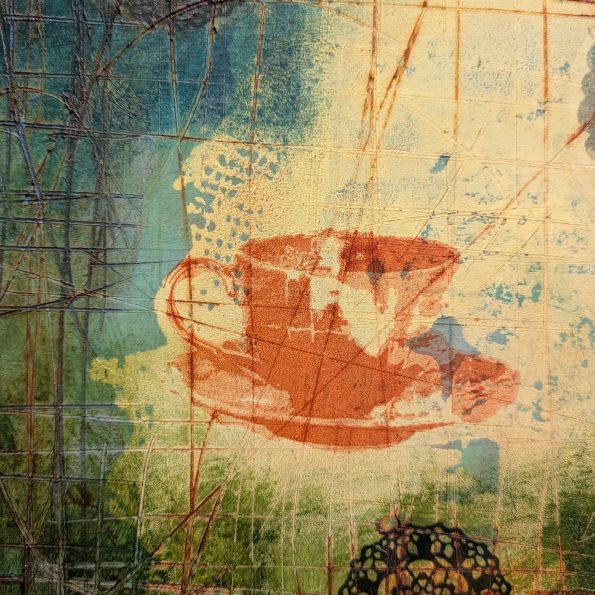
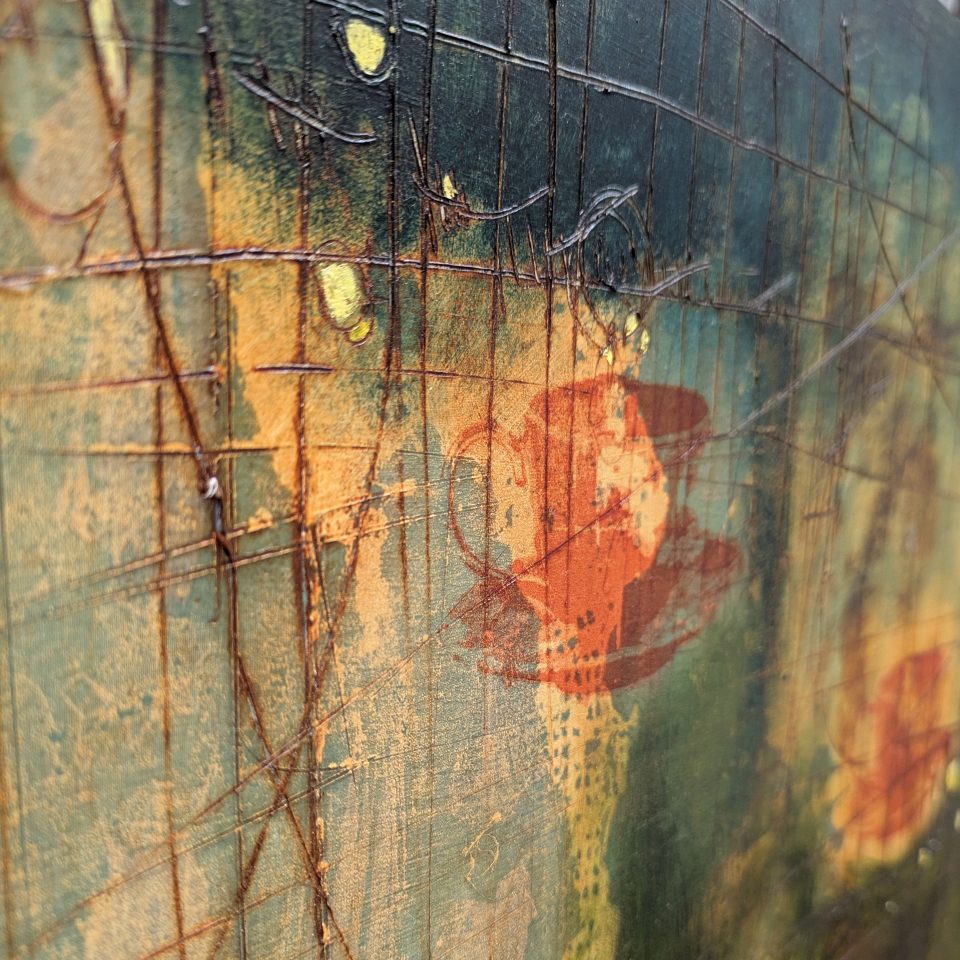
Let’s talk tangibles first – It’s beautiful and honestly, I don’t know how I captured the colors in it. It happens sometimes that the layers collect over one another in a way that stuns even the hand that made it. It’s glorious and it glows like few paintings I have ever made. The painting is on a long horizontal panel. This is a nod to the passage of time, reminiscent of a timeline without drawing a line. Embedded in the lower layers are screen printed tea cups, etched grids and tissue printed with dollies. They are beneath the surface layers though they rise and fall with the changing of the colors. It’s a deep cradled panel finished in white so no frame is needed to encased the piece.
Moving on to the conceptual elements of the painting. It is a small documentation of simply trying to be everything society asks of a woman. So many of the women I know are multitaskers to the nth degree; trying to balance work, parenthood, identity, fulfillment, relationships and emotional sanity, all while keeping everyone fed, the house clean(ish) and the bills up to date. Not to mention being bombarded by ridiculous standards of how we should look, what we wear and who we should be aspiring to be at the same time. It’s close to impossible. There are times I look back on in my life where I can’t even fathom how I did everything I did. Sometimes we are close to empty, running on fumes and just trying to hold it together. This painting developed from a moment of seeing this clearly in the form of a nearly empty teacup. I don’t know why that triggered it, but it did. The piece swirls concrete images of romanticized domestic life – tea cups and doilies, with jarring grids (I often use grids in my work as symbols of societal norms and expectations.) and marks which catch them in a net of color. The rich blues and greens are like a deep body of water surrounding and drowning the images as they rise and fall to and from the surface. A visual representation of all the complexity that exists in each of us as we move through each day and our various roles in the society.
Now the title – I don’t think she ever knew her cup was near to empty. You all know I wrap up a lot into my titles. I could probably write a book about the relationship of painting and title. But I will spare us all and mention just two things I’d like to point out. One: the cup is not empty. ‘She’ is still striving and working and continuing to put one foot in front of the other. She is not broken. Her head is still above the water in those seas of societal expectation.
And the second point: there are two people in the title – “I” and “she”. It is relational. We are relational. All of my work is fundamentally about relationships. It is an acknowledgment that we all need others to come beside us once in a while to remind us when we might be spreading us a bit too thin and maybe even fill up our cups a little. We all keep on, doing so much and being so many different things at different times. We all drain our cups on a regular basis. But hopefully, we also fill one anothers in turn.

by Sawan White | Sep 17, 2024 | paintings
When I first studied abroad in England I got thrown into the Printmaking department and I will confess (since it’s years later) that I didn’t actually know what that meant. I had, of course, heard of etchings and lithographs when I studied art history, and done a lino cut in high school art class; but I had never actually considered that it was a thriving area of study. But from my first step into that print studio I was hooked. The huge beautiful presses with hand over hand wheels, the smell of ink warming on the hot plates, everywhere I looked I saw people carving and refining, lifting paper and inking plates, all with such precision and care. It was love at first sight.
Since I’ve come back to printmaking lately I thought I might write a little bit about the printing process and just how the woodblock monoprints started. It’s always fun to hear how an idea developed and printmaking as a whole can be very misunderstood. The confusion stems mainly from the fact that the term print can have several meanings. When an artist says they make prints, they can mean two things. First they can be referring to creating a reproduction – a copy of an original piece of artwork, usually a giclee print on fine quality paper. They are usually signed and sometimes editioned, but they are not the original piece of artwork. The second meaning can be a print in which the print itself is the original artwork. A print is any artwork which involves inking up a plate of some kind and then transferring the ink to paper, fabric or some other substrate. The plate can be made of all kinds of materials and the type of printmaking is usually determined by this. For example, etching involves creating a plate out of metal (usually copper or zinc), lithography is usually a stone plate, and woodblock – you guessed it – is wood. Within these genres there are lots of different ways to print, but I won’t get into that today. The important thing to note is that the print itself is the original artwork, even if it’s an edition. So to walk through a very simplified example – let’s say I want to make an etching. I get a copper plate, place a ground, etch lines into it either by hand or using acid to bite into the plate. I wipe ink onto the plate and print it onto paper. I decide that it will be an edition of 25, meaning that there will be 25 numbered identical prints in the run and then the plate will be retired. I will ink up and print the plate only 25 times (and maybe a few Artist Proofs). Each of the 25 prints is an original work of art.
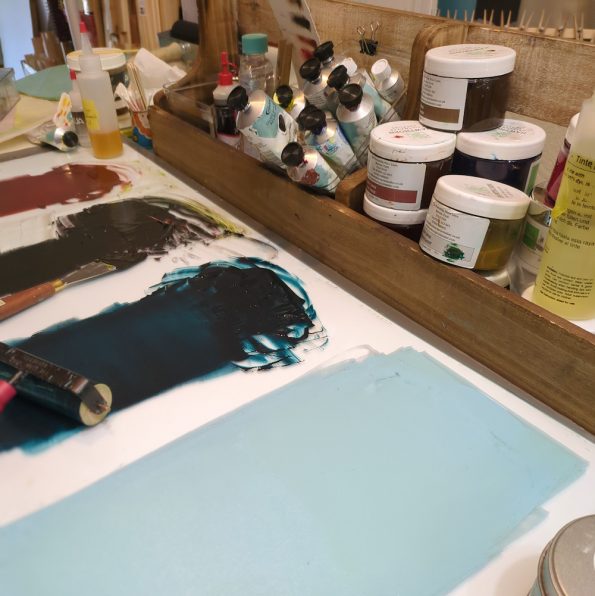
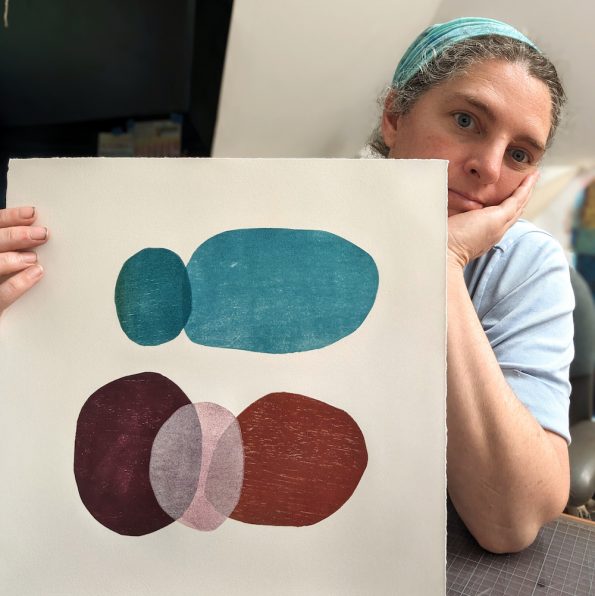
My current prints are original, they are the work of art itself made by inking up wood plates and printing them on paper. They are also monoprints, meaning that they are one of a kind, not an edition. The combination of colors, plates and composition on any given print is unique to that print only. I have a library of plates I’ve created from different types of wood. Each type of wood is unique with different grains and printing properties. I also vary the viscosity of the inks which means that they stick to the plates differently allowing for varying coverage and transparency. After a collection of plates are inked up I then print them one or two at a time on printmaking paper (my favorites are Arches and mulberry). Strictly speaking woodblock printing is done on thinner paper and barrened by hand. However I’m really liking the effects I get by running the plates through my press on a thicker paper. I suppose that gets to the heart of what I love most about printmaking. It’s a highly process orientated art form yet so full of opportunities to experiment. My current prints developed out of me experimenting with bits of left over wood floating around my studio. I needed a break from painting one day and on a whim inked up a random piece of the wood and ran it through the press. I had forgotten the quiet and deliberate nature of printing and just how soothing it can be. The act of inking and printing and reprinting was meditative, becoming a recurring source of peace and inspiration for me. Each print is printed several times, with the plates overlapping and interacting as if in its own little conversation. And they don’t always magically work; for every one or my print you see online there are several more that you don’t see. Ones that weren’t successful with a bad overlap, a plate slippage, or simply a bad composition. The challenge and anticipation of building the perfect print is what keeps me coming back to the press over and over again.
So that’s my tiny printmaking introduction. I’m planning of doing a few more posts on different aspects of printing (starting with inks!) but if there’s something you’d like to hear more about comment below and I’ll see what I can do. Thanks for tuning in and happy printing!
by Sawan White | Oct 29, 2019 | things I like
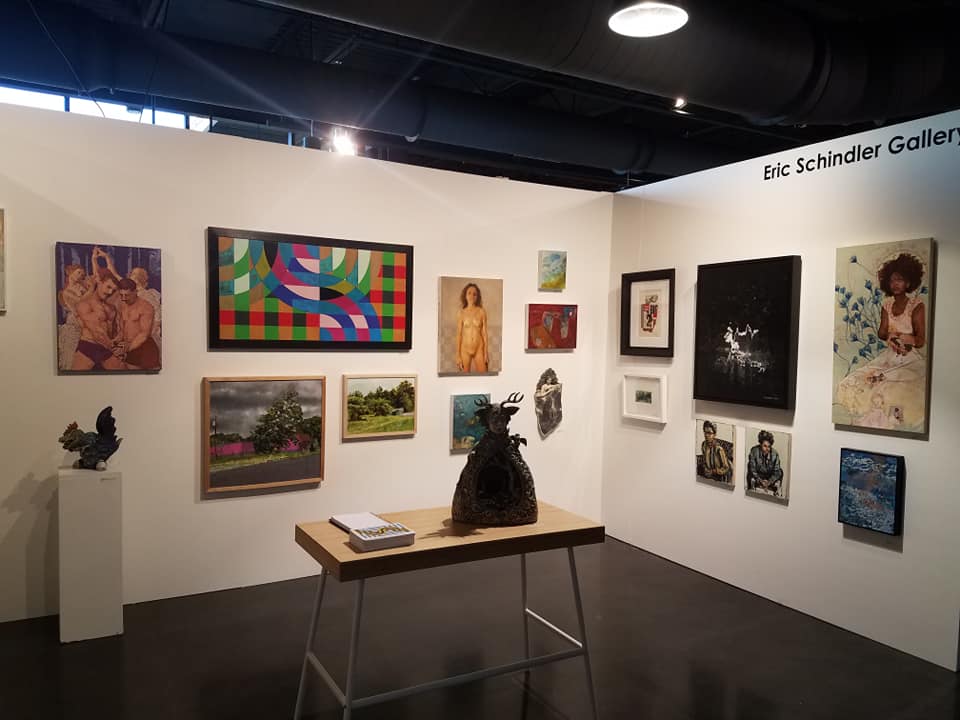
Hey RVA, there’s lots of great ways to see some of my new work this fall. Current Art Fair, VA’s Contemporary Art Fair was this past weekend but no worries if you missed it. Art Style Design Richmond is coming up Nov 9&10 at the Highpoint. And ThinkSmall 10 is the same weekend at artspace gallery in Plant Zero! So go see some art and maybe pick up a piece or two.
by Sawan White | Sep 4, 2019 | paintings, things I like
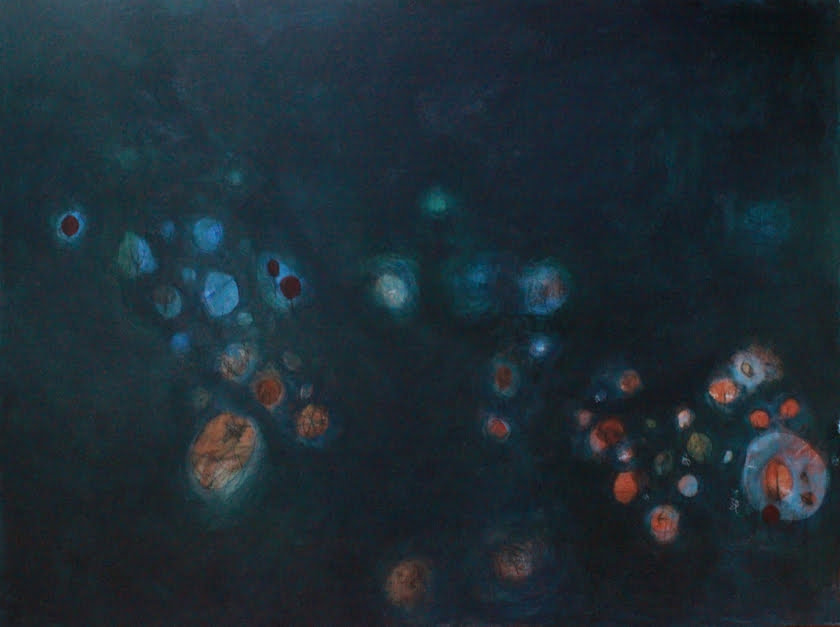
I am so pleased to announce the opening of an exhibition of my work at a delightful new gallery in Taipei, Taiwan. 嘉俬房 & other Art things will open R. Sawan White on Saturday, September 7, 2019.
For more information check out the gallery on facebook or instagram!