Time Dilation – Exhibition Concept
Time is a curious thing
Time is a curious thing. We are surrounded by countless ways to measure it, manage it, and use it wisely. Yet, in reality, time cannot be held, stored, or revisited. It is the medium through which we build our lives and relationships, mark milestones, and map our memories.
For the most part, we understand time to be constant, passing with the predictable precision of a clock. A minute is a minute, a second a second. The clock on my phone matches the clock on yours. But the scientific concept of time dilation challenges this familiar understanding. Rooted in Albert Einstein’s Theory of Special Relativity, time dilation describes how the passage of time varies depending on an observer’s motion and gravitational environment. Without diving into a physics lesson, the essential idea is that forces such as speed and gravity can alter the rate at which time passes for an observer. For most of us, these variations are so subtle that they remain imperceptible; our clocks continue to align with those around us. The physical science of time dilation, therefore, remains largely an abstract concept in everyday life. Fortunately, I am an abstract artist, and abstraction is where I find natural home.
I began to consider not the physical perspective of an observer, but the emotional, mental, and spiritual dimensions of experiencing time. How might the gravitational pull of a life-altering event, or the velocity of a changing relationship, alter the way time unfolds for an individual?
We have all experienced moments when time seems to drag endlessly or race forward in a blur. Think back to childhood, waiting for a birthday to arrive or for school to end for the summer. Those days could feel interminable. As adults, we may experience the same sensation during a seemingly endless workday, while vacation days disappear almost as soon as they begin. Our perception of time shifts according to our emotional and mental relationship to the moment. This, to me, is time dilation from a different perspective.
My lasts and firsts
Last year, my only child left for college. That transition was marked by a succession of lasts and firsts that left my mind spinning and my heart aching. It was beautiful, exciting, and terrifying all at once. Time behaved strangely during this period: some moments seemed to retreat into memory almost instantly, while others lingered vividly in my mind. The days felt long, yet the months passed quickly. It was a profound reminder of how unpredictable and malleable our experience of time can be.
This body of work explores these observations and the ways our understanding of time transforms in response to our circumstances, age, experiences, and emotional states. Each piece gathers moments, both significant and seemingly insignificant, while shifting the perspective from which they are experienced and remembered.
time in paint
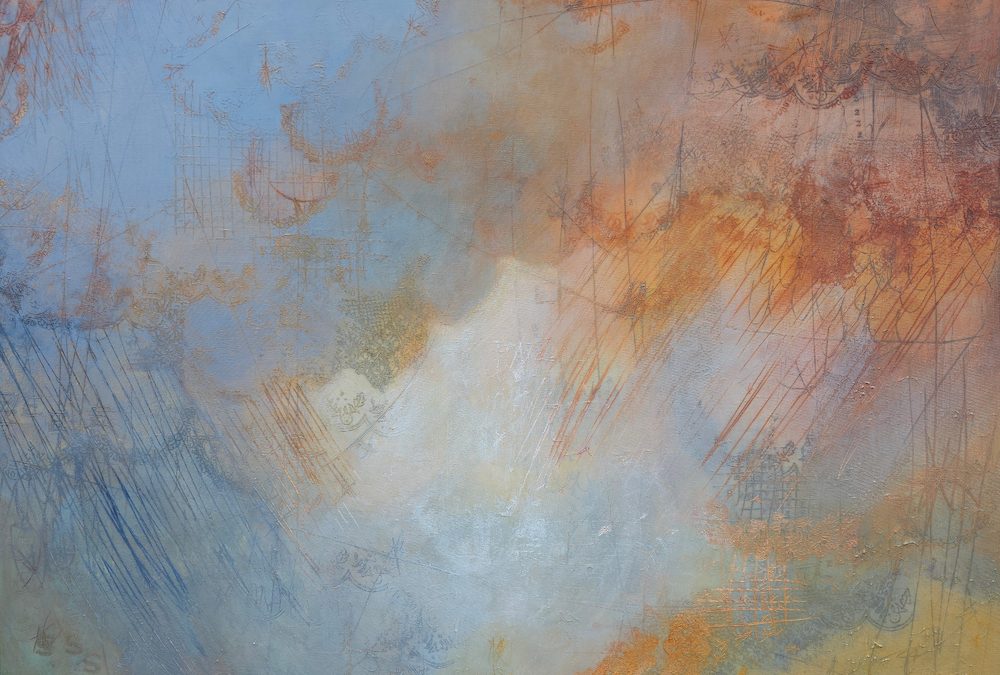
Grid-like forms appear throughout the series, evoking the structure of a calendar. At times, these grids recede to the edges of the composition, their colors barely visible; at others, they divide the surface into clearly defined spaces. Days sometimes appear expansive and vivid, while at other times they quietly slip toward the margins. Layers of pattern in the backgrounds suggest successive layers of wallpaper, traces of what came before, repeatedly concealed yet never entirely erased. Each painting becomes a record of time as a layered, evolving experience—a gathering of the emotional and mental moments that accumulate to shape our understanding of an event or period in our lives.
The fickle nature of time emerges through contrasts between the constrained and the ethereal, the representational and the abstract. Throughout the series, imagery shifts between recognizable forms and deliberate ambiguity. We are never just one thing, and neither is time. Some moments contain the weight of a lifetime: pivotal experiences that become permanently etched in memory, blurring the boundaries between past and future. Others are simply steps along the way, absorbed into the ordinary rhythms of daily life and eventually forgotten.
There is one constant in our experience of time: it moves in only one direction. We cannot return to what has passed. Yet we continually find ourselves wishing to accelerate or slow its progression, shifting our perspective in the hope of changing what cannot be changed. This is both the beauty and the heartache of time.
Our identities and relationships are in a constant state of transformation. We gather experiences, carry memories, and move through moments that shape who we become. Ultimately, all we can do is seek to anchor ourselves in what matters most—in the connections, relationships, and experiences that endure. We build our lives from everything we gather along the way.
May we build them well.
